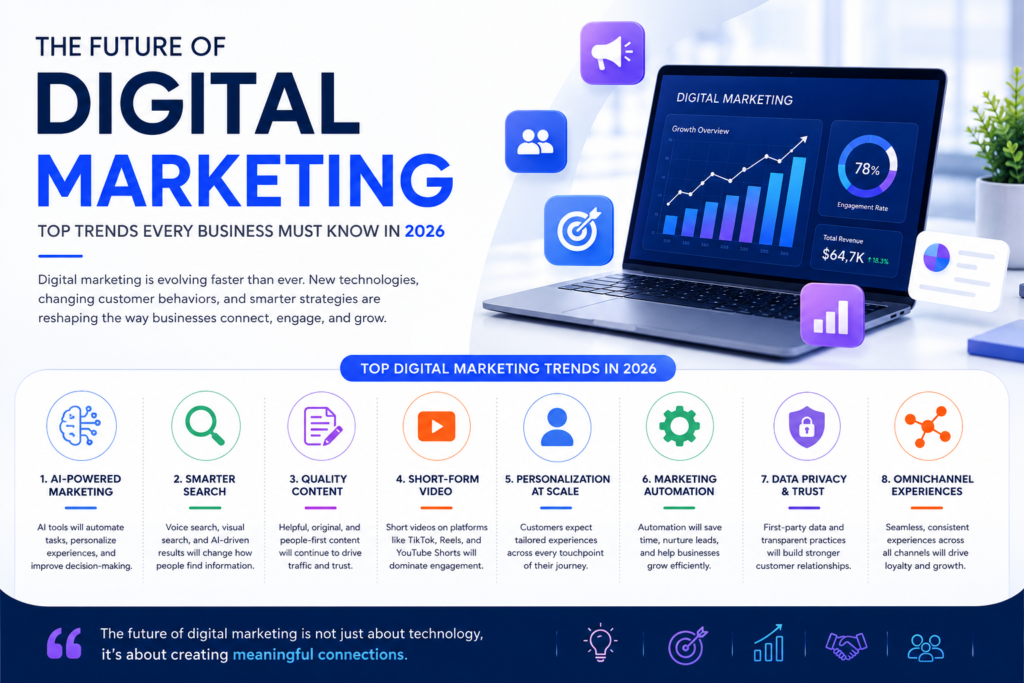
Digital marketing has always evolved alongside technology, but the pace of change today is unlike anything we’ve seen before. Artificial intelligence is reshaping how businesses create content, search engines are becoming more conversational, consumers expect personalized experiences, and social media platforms continue to introduce new ways for brands to connect with audiences.
Thank you for reading this post, don't forget to subscribe!For business owners, marketers, and entrepreneurs, keeping up with these changes isn’t just about staying current—it’s about staying competitive.
The strategies that generated leads five years ago aren’t guaranteed to work today. Businesses that embrace innovation and adapt to changing consumer behavior will be better positioned to build stronger relationships, improve customer experiences, and achieve sustainable growth.
In this guide, we’ll explore the most important digital marketing trends shaping 2026, explain why they matter, and share practical ways you can apply them to your business.
Why Digital Marketing Matters More Than Ever
Consumers now spend a significant portion of their day online. Whether they’re researching products, reading reviews, watching videos, or comparing services, digital channels influence nearly every purchasing decision.
This means businesses can no longer rely on a single marketing channel. Success comes from creating a connected experience across websites, search engines, social media, email, and paid advertising.
Digital marketing also offers advantages that traditional marketing cannot easily match:
- Real-time performance tracking
- Highly targeted advertising
- Lower customer acquisition costs
- Personalized customer experiences
- Scalable campaigns
- Measurable return on investment (ROI)
Companies that invest in a well-rounded digital marketing strategy are more likely to attract qualified leads, increase customer loyalty, and adapt quickly as the market changes.
1. Artificial Intelligence Is Becoming Every Marketer’s Assistant
Artificial intelligence (AI) is no longer a futuristic concept—it’s a practical tool that businesses of all sizes can use today.
Instead of replacing marketers, AI helps them work more efficiently by automating repetitive tasks, analyzing large datasets, and generating ideas faster.
Businesses are using AI to:
- Write first drafts of blog posts and emails
- Generate social media captions
- Create ad variations
- Analyze customer behavior
- Predict purchasing patterns
- Improve customer support with AI-powered chatbots
- Personalize marketing campaigns
For example, an online retailer can use AI to recommend products based on a customer’s browsing history. This creates a more relevant shopping experience while increasing the chances of a sale.
However, successful brands don’t rely solely on AI-generated content. Human creativity, industry expertise, and authentic storytelling remain essential for building trust and standing out in a crowded market.
Key takeaway: Use AI to improve efficiency, but always add your own insights, expertise, and brand voice.
2. Search Is Becoming More Conversational
People are changing how they search online.
Instead of typing short keywords like:
“best CRM software”
Users now ask complete questions such as:
“What’s the best CRM software for a small business with fewer than 20 employees?”
This shift has accelerated with AI-powered search experiences and voice assistants.
To stay visible, businesses should create content that answers real customer questions in a natural, conversational way.
Effective strategies include:
- Writing detailed how-to guides
- Publishing FAQ pages
- Using question-based headings
- Explaining topics in simple language
- Covering related subtopics thoroughly
Rather than focusing only on keywords, marketers should focus on solving problems.
When your content provides clear, trustworthy answers, search engines are more likely to recognize it as valuable.
3. Quality Content Is Still the Foundation of SEO
Despite constant algorithm updates, one principle remains consistent:
Helpful content wins.
Search engines aim to deliver the most useful information to users. That means businesses should prioritize creating content that demonstrates expertise, experience, authority, and trustworthiness.
Strong content should:
- Answer the reader’s question completely
- Include original insights
- Be easy to read
- Stay up to date
- Include credible examples
- Address common challenges
- Offer practical solutions
Publishing one comprehensive guide often provides more long-term value than publishing several short, shallow articles.
Instead of asking, “How many blog posts should we publish each month?”
A better question is:
“How can we create content that’s genuinely more useful than what’s already ranking?”
That mindset leads to stronger search visibility over time.
4. Short-Form Video Continues to Dominate
Video remains one of the most engaging forms of online content.
Platforms such as Instagram Reels, TikTok, YouTube Shorts, and LinkedIn video encourage businesses to educate, entertain, and inspire audiences through bite-sized content.
Short-form videos are effective because they:
- Capture attention quickly
- Increase engagement
- Improve brand awareness
- Reach new audiences organically
- Encourage sharing
Businesses don’t need expensive equipment to create successful videos.
Some of the highest-performing videos include:
- Quick marketing tips
- Product demonstrations
- Customer success stories
- Behind-the-scenes content
- Industry updates
- Frequently asked questions
Consistency matters more than perfection.
Audiences often respond better to authentic, informative videos than highly polished advertisements.
5. Personalization Is Becoming the Standard
Today’s customers expect brands to understand their needs.
Generic marketing messages are becoming less effective because consumers are constantly exposed to advertisements.
Personalization helps businesses deliver relevant experiences based on customer behavior, interests, and preferences.
Examples include:
- Personalized email recommendations
- Dynamic website content
- Product suggestions
- Customized advertisements
- Location-based offers
Imagine two visitors browsing an online clothing store.
One recently viewed running shoes.
The other searched for winter jackets.
Showing both visitors the same homepage misses an opportunity.
Instead, personalized experiences increase relevance, improve customer satisfaction, and often lead to higher conversion rates.
The key is using customer data responsibly while respecting privacy and maintaining transparency.
6. Social Media Is Shifting Toward Communities
For many years, brands focused primarily on growing follower counts.
Today, engagement matters far more than vanity metrics.
Successful businesses are building communities where customers actively participate in conversations rather than simply consuming content.
Brands can strengthen their communities by:
- Responding to comments
- Hosting live Q&A sessions
- Creating interactive polls
- Encouraging user-generated content
- Sharing customer success stories
- Asking meaningful questions
A smaller, engaged audience often delivers better business results than a much larger audience that rarely interacts with your content.
Building relationships creates loyalty—and loyal customers become powerful advocates for your brand.
7. Marketing Automation Is Helping Businesses Work Smarter
Running a successful marketing campaign involves dozens of moving parts. From sending emails and posting on social media to nurturing leads and tracking customer behavior, managing everything manually can quickly become overwhelming.
This is where marketing automation becomes a game changer.
Marketing automation allows businesses to streamline repetitive tasks while delivering a more personalized experience to customers. Instead of spending hours manually following up with leads or scheduling social media posts, marketers can create automated workflows that save time and improve efficiency.
For example, imagine someone downloads a free guide from your website. Rather than waiting for a team member to send a follow-up email, an automated workflow can immediately:
- Send a welcome email with the downloadable resource.
- Introduce your company and its services.
- Share additional educational content over the next few days.
- Invite the lead to book a consultation or request a demo.
This creates a consistent customer experience while allowing your team to focus on strategy and relationship building.
Popular areas where businesses use marketing automation include:
- Email marketing campaigns
- Lead nurturing sequences
- CRM updates
- Social media scheduling
- Customer onboarding
- Abandoned cart reminders
- Customer feedback requests
The key is finding the right balance. Automation should support meaningful customer interactions—not replace genuine human communication.
8. Data Privacy Is Reshaping Digital Marketing
Consumers today are more aware than ever of how their personal information is collected and used. As privacy regulations continue to evolve and third-party cookies become less reliable, marketers must rethink how they gather customer insights.
The future of digital marketing is built on trust.
Instead of relying heavily on purchased data, businesses should focus on collecting first-party data—information that customers willingly share through interactions with your brand.
Examples include:
- Newsletter sign-ups
- Website registrations
- Purchase history
- Customer surveys
- Loyalty programs
- Contact forms
When customers understand why you’re collecting their information and how it benefits them, they’re more likely to engage with your business.
Transparency also strengthens brand reputation. Clear privacy policies, secure data practices, and honest communication demonstrate that your company values customer trust.
Businesses that prioritize ethical data collection will have a competitive advantage as privacy expectations continue to grow.
9. Voice and Visual Search Are Changing Consumer Behavior
Search is no longer limited to typing keywords into a search engine.
Millions of people now use voice assistants to ask questions, while others search using images instead of text.
For example, someone might ask:
“What’s the best Italian restaurant near me?”
Or they may upload a photo of a piece of furniture to find similar products online.
These changes create new opportunities for businesses to improve their online visibility.
To optimize for voice search:
- Answer common customer questions naturally.
- Use conversational language.
- Include FAQ sections on important pages.
- Optimize for local searches.
- Keep business information accurate across online directories.
For visual search:
- Use high-quality images.
- Add descriptive file names.
- Write meaningful image alt text.
- Organize product catalogs clearly.
As search continues to evolve, businesses that make their content easier for both people and technology to understand will remain ahead of the competition.
10. Influencer Marketing Is Becoming More Authentic
Influencer marketing has matured significantly over the past few years.
Rather than partnering only with celebrities who have millions of followers, many brands now collaborate with micro-influencers and niche creators who have highly engaged communities.
Why?
Because trust often matters more than reach.
A creator with 15,000 loyal followers can sometimes generate better results than someone with two million followers who has low audience engagement.
Consumers value honest recommendations from people they trust.
Successful influencer partnerships typically involve:
- Product demonstrations
- Educational content
- Honest reviews
- Behind-the-scenes experiences
- Long-term collaborations
- User-generated content
The most effective campaigns feel natural rather than overly promotional.
Businesses should look for creators whose audience genuinely aligns with their products or services instead of choosing influencers based solely on follower count.
11. Omnichannel Marketing Creates Better Customer Experiences
Modern customers rarely interact with a business through just one channel.
A potential customer may discover your company on Instagram, visit your website, subscribe to your newsletter, read online reviews, and finally make a purchase after seeing a Google advertisement.
Each interaction contributes to the overall customer journey.
Omnichannel marketing focuses on creating a seamless experience across every touchpoint.
This means maintaining consistent messaging, branding, and customer service regardless of where someone interacts with your business.
An effective omnichannel strategy includes:
- A mobile-friendly website
- Active social media profiles
- Email marketing
- Paid advertising
- Search engine optimization
- Customer support
- CRM integration
When these channels work together, customers experience a smoother journey, leading to stronger relationships and increased loyalty.
12. Measuring Success With the Right Marketing Metrics
One of the greatest advantages of digital marketing is its measurability.
Unlike traditional advertising, digital campaigns provide detailed insights into what is—and isn’t—working.
However, focusing on the wrong metrics can lead to poor decision-making.
Instead of obsessing over vanity metrics such as follower count or page likes, businesses should prioritize metrics tied to meaningful outcomes.
Key performance indicators (KPIs) include:
- Website traffic
- Conversion rate
- Cost per lead
- Customer acquisition cost
- Return on ad spend (ROAS)
- Customer lifetime value
- Email open and click-through rates
- Organic search traffic
- Lead quality
- Revenue generated
Regularly reviewing these metrics helps marketers identify opportunities for improvement and allocate budgets more effectively.
Common Digital Marketing Mistakes to Avoid
Even experienced marketers can make mistakes that reduce campaign performance. Avoiding these common pitfalls can save time, money, and frustration.
Some of the most common mistakes include:
- Ignoring search engine optimization.
- Publishing content without understanding audience needs.
- Focusing only on selling instead of educating.
- Neglecting website speed and mobile optimization.
- Inconsistent branding across channels.
- Failing to analyze campaign performance.
- Posting irregularly on social media.
- Depending on a single traffic source.
- Overusing AI-generated content without human editing.
- Ignoring customer feedback.
Digital marketing works best when businesses consistently test, learn, and improve their strategies.
Frequently Asked Questions
What is the biggest digital marketing trend in 2026?
Artificial intelligence is one of the most influential trends. Businesses are using AI to improve content creation, customer service, personalization, campaign optimization, and marketing automation while still relying on human expertise for creativity and strategic decision-making.
Is SEO still important in 2026?
Absolutely. SEO remains one of the most cost-effective ways to attract qualified traffic. However, success now depends on creating helpful, trustworthy, and experience-driven content rather than simply targeting keywords.
Which social media platform is best for businesses?
The best platform depends on your audience. LinkedIn works well for B2B companies, Instagram and TikTok are effective for visual brands, Facebook remains valuable for local businesses and communities, while YouTube continues to be a leading platform for educational content
Should small businesses invest in digital marketing?
Yes. Digital marketing allows small businesses to compete with larger companies through targeted advertising, local SEO, content marketing, and social media engagement, often with a more affordable budget than traditional advertising.
Conclusion
Digital marketing is evolving faster than ever, but the core objective remains the same: helping businesses connect with the right audience at the right time with the right message.
The technologies and platforms may change, but long-term success will always depend on understanding customer needs, delivering genuine value, and building trust.
Businesses that embrace artificial intelligence responsibly, invest in high-quality content, optimize for changing search behaviors, personalize customer experiences, and measure meaningful results will be well positioned for success in 2026 and beyond.
Instead of trying to adopt every new trend at once, start with the strategies that align with your business goals. Test, measure, refine, and continue learning. Digital marketing is not a one-time project—it’s an ongoing process of improvement.
The companies that remain curious, adaptable, and customer-focused won’t just keep up with the future of marketing—they’ll help shape it.