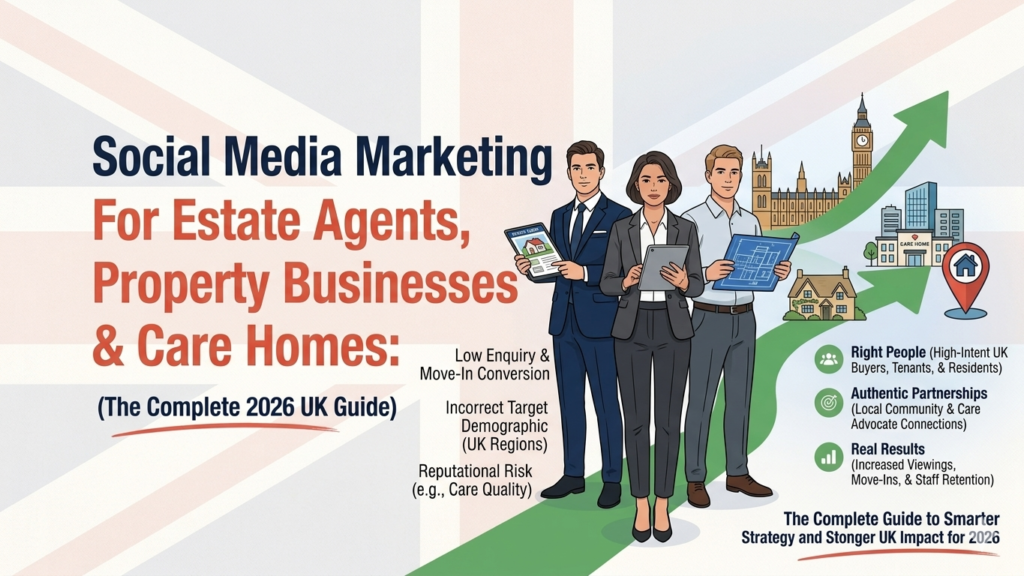
Social media marketing works differently for estate agents, property businesses, and care homes, but all three share a need for trust-building content, local authority, and consistent posting. Estate agents perform best on Facebook and Instagram. Property developers and investors should prioritise LinkedIn. Care homes should focus on Facebook and build content around community, care quality, and transparency always in line with CQC and GDPR compliance requirements.
Table of Contents
Social Media Marketing for Estate Agents
Estate agents operate in a trust-first industry. Before a vendor or buyer chooses your agency over the competitor two doors down, they need to know you, like you, and trust you know your local market better than anyone else. Social media is the most efficient way to build that trust at scale — and the UK estate agency sector is significantly underusing it in 2026.
Thank you for reading this post, don't forget to subscribe!79% of UK property buyers research estate agents on social media before making first contact — yet fewer than 30% of UK agencies post consistently. This gap is your opportunity.
Best Social Media Platforms for Estate Agents
- Facebook — Primary platform. The 35–65 demographic making most property decisions is most active here. Local Facebook Groups are particularly powerful for neighbourhood authority building.
- Instagram — For property photography and lifestyle content. Reels of property walkthroughs generate strong organic reach with younger first-time buyers.
- LinkedIn — For commercial property, investors, and professional authority. Also valuable for high-value recruitment and building referral partnerships.
- TikTok — Fast-growing opportunity. First-time buyer content and “day in the life of an estate agent” formats are building significant organic followings.
Best Content Types for Estate Agent Social Media
- Property tour videos — Walk-through tours of new listings consistently get the highest organic reach of any property content. Under 60 seconds on Instagram and TikTok; 3–5 minutes on Facebook and YouTube.
- Local market data posts — “Here is what sold in [area] this month and for what price.” This positions you as the undisputed local market authority and gets shared by local residents and property researchers.
- Neighbourhood highlight content — Local restaurant openings, Ofsted-rated schools, new transport links, community events. Shareable content that reaches new audiences at zero cost.
- Client testimonials — Video testimonials from happy vendors and buyers are the most powerful trust-building content an estate agent can publish. Even a 30-second iPhone clip outperforms any written review.
- Behind-the-scenes content — “What actually happens between listing and completion” demystifies the process, reduces buyer anxiety, and positions your team as expert guides rather than salespeople.
- Educational buyer and seller content — “What to look for at a property viewing,” “How to prepare your home for sale in 2026,” “What stamp duty means for first-time buyers.” This builds trust before a single listing is even on the table.
Estate Agent Social Media — Monthly Content Skeleton
| Week | Content Theme | Platform | Format |
|---|---|---|---|
| Week 1 | New listing showcase | Facebook + Instagram | Photo album + Reel walkthrough |
| Week 2 | Local market data | Facebook + LinkedIn | Infographic + text commentary |
| Week 3 | Client testimonial + sold | Instagram + Facebook | Video testimonial + graphic |
| Week 4 | Educational buyer/seller tip | All platforms | Carousel + educational caption |
| Ongoing | Neighbourhood highlights | Facebook + Instagram | Short video or photo + story |
Social Media Marketing for Property Businesses
Property businesses — developers, landlords, property management companies, and buy-to-let specialists — have distinct social media needs from estate agents. Their audience is more likely to be investors, commercial buyers, or landlords, which shifts both platform priorities and content tone significantly.
Platform Priority for Property Businesses
- LinkedIn — Primary platform for property investment content. Thought leadership on UK market conditions, investment case studies, and planning system changes performs strongly.
- YouTube — Long-form content covering investment strategy, development case studies, and market analysis builds significant authority with serious property investors.
- Instagram — New development showcases, construction progress updates, and luxury property lifestyle content.
- Facebook Groups — For landlord communities, buy-to-let networks, and local property investment circles.
Content Ideas for Property Marketing on Social Media
- Monthly development progress updates with before-and-after imagery
- UK property market commentary backed by Land Registry or Rightmove data
- Investment return case studies (anonymised where required)
- Planning permission process explainers — demystifying the system for lay audiences
- Build-to-completion transformation series
- Regional rental yield data and buy-to-let market analysis
- Architect, contractor, and planning consultant interviews
Social Media Marketing for Care Homes
Social media marketing for care homes requires sensitivity, compliance awareness, and a genuine commitment to transparency. The primary goal is not viral content — it is building the trust of families making one of the most emotionally demanding decisions of their lives: where to place a parent or loved one in care.
⚠️ UK Compliance Note — Essential Reading for Care Homes
Before posting any content featuring residents: obtain explicit written consent (not verbal — written). Follow CQC guidance on digital communications. Comply with ICO GDPR requirements for content featuring individuals. Staff appearing in content should also provide signed consent. When in doubt, consult your legal adviser before publishing. This section is informational only and does not constitute legal advice.
Best Platforms for Care Home Social Media Marketing
- Facebook — Primary platform. The 45–70 age group making most care placement decisions is most active here. Facebook also enables local community engagement through Groups.
- Instagram — Effective for showcasing facilities, gardens, activities, and the atmosphere of the home through high-quality photography and short video.
- LinkedIn — For NHS and local authority commissioner relationships, professional recruitment, and sector reputation building.
What Content Works for Care Home Social Media
- Activity highlights — Seasonal activities, celebrations, live entertainment, and visiting performers. Reassures families that their loved ones are engaged, stimulated, and genuinely enjoying life.
- Staff introductions — Short posts or videos introducing carers, nurses, and activity coordinators by name. Families choose care homes based on the people as much as the facilities.
- Facility showcases — Photography and video tours of rooms, gardens, lounges, dining areas, and specialist facilities. High-quality imagery builds confidence before a family visit.
- Community partnerships — Content about relationships with local schools, community groups, and NHS partners signals stability and community integration.
- Educational content for families — “What to look for when choosing a care home,” “How to talk to a parent about moving into care,” “What questions to ask on a care home visit.”
Seasonal and celebration content — Christmas, Easter, Bonfire Night, summer fetes, and community events. These show the home as a vibrant, joyful community.
What Care Homes Should Never Post on Social Media
- Never post content featuring residents without explicit written consent — no exceptions
- Never make exaggerated or unsubstantiated claims about care quality (ASA advertising standards apply)
- Never respond publicly to negative reviews — take all complaints offline and through proper channels
- Avoid overly clinical or institutional language — warm, human, community-focused language performs better
- Never post content that could identify a resident’s medical condition or care needs
What All Three Sectors Share: The Trust Imperative
Despite their differences, estate agents, property businesses, and care homes face the same fundamental social media challenge: they are all trust-first industries. People do not choose an estate agent, property developer, or care home based on a single social media post. They choose based on accumulated trust built through consistent visibility, demonstrated expertise, and authentic personality over time.
The organisations winning on social media in all three sectors are those that treat it as a long-term trust-building investment — not a short-term lead generation tactic. Consistent, genuine, valuable content published week after week is what builds the kind of reputation that makes the phone ring.
Need a Social Media Strategy for Your Property or Home-Adjacent Business?
Brand Builderz builds specialist social media strategies for home goods, interiors, and property-adjacent businesses across the UK. From strategy to execution — done for you by specialists.
Visit brandbuilderz.com to book your discovery call.
What social media platforms should estate agents use in the UK?
UK estate agents should prioritise Facebook (for the 35–65 property-buying demographic and local community reach), Instagram (for property photography and lifestyle content), and LinkedIn (for commercial property and investor-facing content). TikTok is a growing opportunity for first-time buyer content and personal brand building — particularly for agents targeting the under-40 buyer market.
How can care homes market on social media without breaching privacy rules?
Care homes can market on social media compliantly by: obtaining explicit written consent before featuring any resident in content; focusing primarily on activities, facilities, and staff rather than on individual residents; complying with ICO GDPR requirements for content featuring individuals; and following CQC digital communications guidance. Focus on the home’s environment, culture, and staff — not on individual residents — to minimise compliance risk while still producing compelling content.
What type of content should property developers post on social media?
Property developers should post monthly development progress updates, before-and-after transformation content, UK property market commentary backed by data, anonymised investment return case studies, planning process explainers, and team and project spotlights. LinkedIn should be the primary platform for investor-facing content; Instagram works well for visual development showcases and brand awareness.
How often should estate agents post on social media?
Estate agents should aim to post a minimum of 3–4 times per week on Facebook and Instagram combined, with at least one new property listing video, one educational post, and one community or local content piece per week. Consistency matters more than volume — an estate agent posting 3 times every week will outperform one posting 10 times one week and nothing the next.