You’ve got a beautiful product. You know it. Your customers know it.
Thank you for reading this post, don't forget to subscribe!But somewhere between photographing your latest throw pillow collection and hitting “post,” the results aren’t matching the effort. The likes are… fine. The sales from Instagram? Barely traceable. Pinterest feels like a mystery, and you’re not entirely sure whether you should be on TikTok or just accept that you’re a Facebook person now.
I’ve worked with a lot of home goods and e-commerce brands, and this is the conversation I have almost every single time. Not because these business owners aren’t smart or hardworking — they absolutely are. But because social media marketing for small business looks very different from the generic “grow your brand online” advice that floods the internet.
So let’s get into it. No vague platitudes. No tactics that only work if you already have 100k followers. Just what actually works for home goods brands trying to build something real.
Why Home Goods Brands Are Actually in the Perfect Position on Social Media
Here’s something that gets overlooked: you are in one of the most inherently visual, shareable, emotionally resonant industries that exists.
A new SaaS tool? Hard to make exciting on Instagram. A handcrafted ceramic mug that makes someone’s morning ritual feel luxurious, or a linen duvet that transforms a bedroom into something out of a boutique hotel? That’s content people want in their feeds. They save it. They share it. They pin it.
The challenge isn’t the product. It’s almost always the strategy — or the lack of one.
Most small home goods brands post reactively: photograph something, write a caption, share it, hope. That’s not a social media strategy. That’s wishful thinking dressed up as marketing. And I say that with complete compassion, because I’ve watched brilliant founders do it for months before realising why the needle wasn’t moving.
The good news? Once you build an intentional strategy — even a simple one — your content starts doing the heavy lifting for you instead of the other way around.
The Platform You’re Probably Underusing (And It’s Not the One You Think)
Let me be direct with you: if you run a home goods e-commerce store and you’re not prioritising Pinterest marketing, you are leaving significant traffic and revenue on the table every single month.
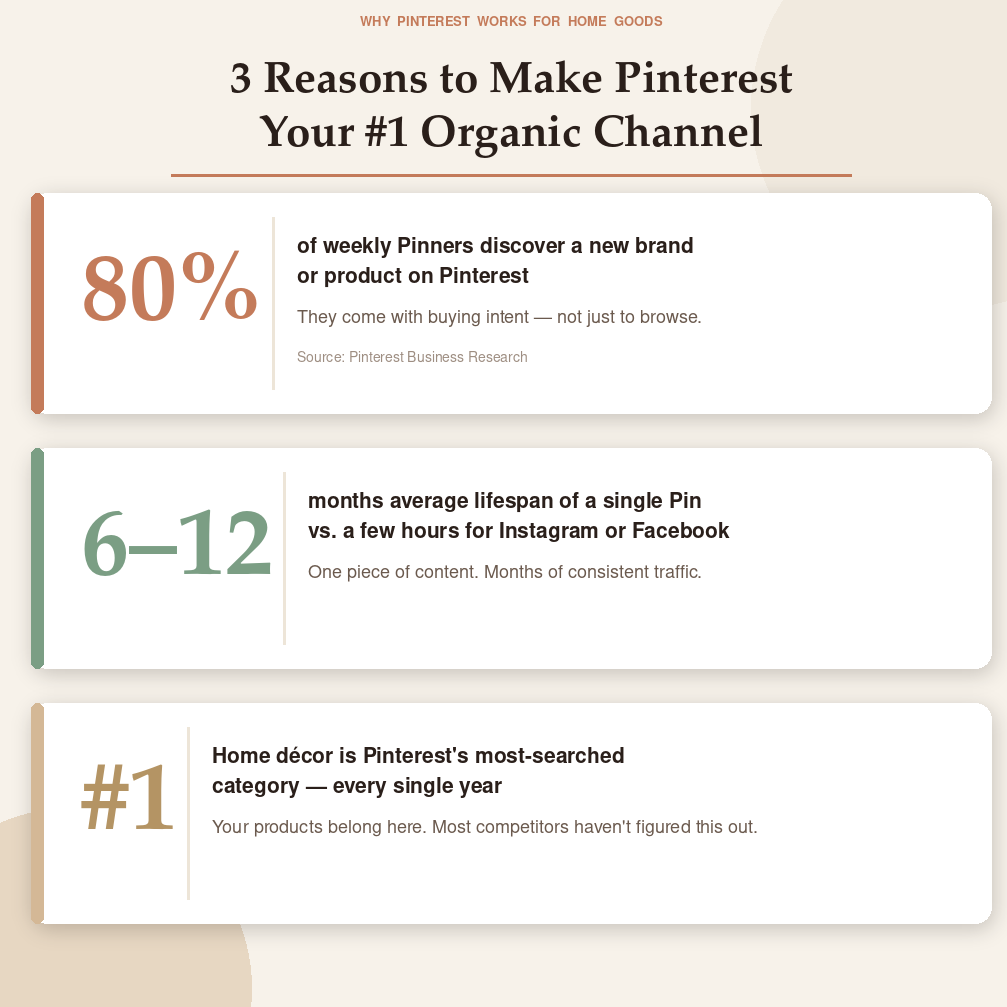
Pinterest is not a mood board app. It is a visual search engine — and one of the highest-converting platforms for home, décor, and lifestyle products in existence. According to Pinterest Business research, 80% of weekly Pinners have discovered a new brand or product on the platform. More importantly, Pinterest users come with buying intent. They’re planning purchases, not just killing time.
Unlike Instagram or Facebook — where a post has a lifespan of a few hours before it disappears into the void — a well-optimised Pin can drive consistent traffic for months, sometimes years. That is compound return on a single piece of content. I have seen Pins from two-year-old product shoots still sending traffic to client stores today.
Here’s what effective Pinterest marketing actually looks like for a home goods brand:
- Build boards around problems and aesthetics, not products. “Cosy Bedroom Ideas for Small Spaces” will outperform “Our Duvet Collection” every single time, because that’s how people search. They’re looking for a feeling, a room, a solution — your product is the discovery.
- Write keyword-rich descriptions. Pinterest SEO is real. Describe your Pins the way someone would type a search query: “Modern minimalist living room with natural textures and warm lighting” beats “New arrival — check it out!”
- Use Rich Pins. These pull real-time product data — pricing, availability, product name — directly from your ecommerce website. They look more professional and they convert better. If you’re not using them, set them up this week.
- Pin consistently using a scheduler. Pinning 10–15 items a day sounds overwhelming, but when you batch and schedule it in advance, it takes far less time than you’d think (more on scheduling tools below).
Pinterest is not the flashiest platform. It rarely goes viral in the way Instagram Reels can. But for home goods brands, it is consistently one of the highest-ROI channels once you understand how it works — and most of your competitors haven’t figured it out yet.
Instagram, Facebook, TikTok, LinkedIn — What Actually Deserves Your Time
I’m not going to pretend every platform is equal, because for home goods SMBs, they genuinely aren’t. Here’s the honest breakdown:
Instagram: Your Brand’s Visual Home
Still essential. This is where your brand lives aesthetically — and for home goods, aesthetic is everything. The focus should be on high-quality lifestyle photography that puts your products in context, Stories for real-time connection and behind-the-scenes moments, and Reels when the content genuinely calls for it (not forced, not cringe-worthy “trending audio” content that doesn’t match your brand).
The shift most brands need to make: stop using Instagram like a product catalogue and start using it like a magazine. Inspire. Educate. Show the before-and-after. Let people fall in love with a lifestyle, and position your products within that world. That’s when the follows and saves — and eventually the sales — start happening.
Facebook: Where the Buyers Are
Facebook gets dismissed by younger-skewing brands, but for home goods targeting the 30–55 demographic — which controls a significant proportion of home purchasing decisions — it remains highly effective. Particularly for social media advertising: Meta’s ad platform gives you audience targeting capabilities that are genuinely unmatched, and the product catalogue integration for e-commerce is powerful once it’s set up correctly.
Facebook marketing for home goods brands often works best as a retargeting channel: bringing back website visitors who browsed but didn’t buy, or re-engaging past customers with new collections.
TikTok: High Effort, High Reward (For the Right Brands)
If you’re willing to show the making of your products — the hand-finishing, the packaging process, the behind-the-scenes chaos of a small business — TikTok’s organic reach potential is still significant. But it requires a fundamentally different approach: entertaining first, branded second. Not every home goods brand belongs here, and that’s a completely valid business decision.
LinkedIn: The Overlooked B2B Opportunity
LinkedIn isn’t where most consumer-facing home goods brands should put their content energy. But if you sell wholesale, work with interior designers, or supply commercial spaces — hotels, offices, restaurants — LinkedIn ads can be surprisingly effective for reaching those buyers. LinkedIn’s Campaign Manager offers job title and industry targeting you simply won’t find on other platforms, making it worth exploring if B2B is part of your revenue mix.
Building a Social Media Strategy That Doesn’t Burn You Out
Here’s where most advice falls short: they tell you what to do, but not how to sustain it while running an actual business.
A realistic social media strategy for a small home goods brand doesn’t require a full-time marketing team. It requires a system.
Step 1: Define your content pillars
Pick three or four content themes you rotate through. For home goods brands, this typically looks like:
- Inspiration — Styled photography, room reveals, aesthetic mood boards
- Education — How to style your products, care guides, “how to choose the right X for Y space”
- Behind the scenes — Your process, sourcing story, packaging moments, team snippets
- Social proof — Customer photos (UGC), reviews, before-and-after transformations
These pillars give you a framework so you’re never staring at a blank phone wondering what to post today.
Step 2: Batch your content creation
Trying to come up with content ideas daily is exhausting and produces inconsistent results. Instead, block out one day or half-day each month to shoot content, write captions, and prepare everything for scheduling. This one habit shift transforms how manageable social media feels.
Step 3: Use a scheduler — and actually commit to it
A social media post scheduler is non-negotiable once you’re posting across more than one platform. The best social media scheduler for your business depends on how many platforms you’re managing, your budget, and what integrations you need. Tools like Later, Buffer, and Zoho Social all do the job well — Zoho Social in particular suits small business owners who want their social scheduling, monitoring, and reporting in one dashboard alongside other business tools.
Social media scheduling platforms remove the daily scramble and let you show up consistently even during your busiest weeks. Consistency is the single most underrated factor in social media growth. The algorithm rewards it. Your audience expects it.
Step 4: Actually engage
Scheduling your content is step one. Engaging with the people who respond is step two. Respond to comments within the first hour if you can — that’s when the algorithm is watching. Answer DMs. Comment on your customers’ posts when they tag you. This is what turns a broadcast channel into a relationship channel, and relationships are what build loyal customers.
Ecommerce Marketing: Making Your Store and Your Social Work Together
Here’s a mistake I see constantly with home goods brands: treating the ecommerce website and the social media presence as two separate things.
Your ecommerce marketing strategy and your social strategy need to be aligned at every touchpoint, because the buyer journey almost never starts at your website. It starts on social.
Set up shoppable posts and product tagging. On Instagram and Facebook, you can tag products directly in posts so users can move from discovery to purchase in a few taps. If this isn’t set up, make it a priority this week.
Your link in bio is a landing page, not an afterthought. Use a tool like Linktree or a custom landing page to direct traffic to your bestsellers, latest collection, current promotions, or recent blog content. Update it regularly.
Align your social calendar with your sales calendar. Launching a spring collection? Your social content for the two weeks prior should be building anticipation — teaser shots, behind-the-scenes glimpses, waitlist CTAs. A sale coming up? Start creating the story before you announce the discount.
Choose a platform that makes integration seamless. The best ecommerce platform for small business from a social commerce perspective is typically Shopify — its native integrations with Facebook, Instagram, Pinterest, and TikTok are genuinely well-built. Shopify’s research on social commerce consistently shows that social is one of the fastest-growing channels for product discovery and purchase. If you’re on another platform, check what social integrations are available and make sure you’re using them.
Social Media Ads: When to Spend and How to Spend Wisely
Social media advertising doesn’t have to mean throwing money at the algorithm and hoping for the best. But it does require some clarity before you open your wallet.
For home goods brands, paid social media ads make the most sense when:
- You have an organic post that’s already getting engagement and you want to extend its reach
- You’re launching a new product or collection and need initial visibility beyond your existing followers
- You’re retargeting website visitors who viewed a product but didn’t purchase (this is often the highest-ROI use of paid budget)
- You want to reach a specific audience — by interest, location, life stage, or purchase behaviour
Facebook and Instagram are the most accessible entry points for SMBs and give you the most sophisticated targeting options. Pinterest ads are underutilised by small brands but can deliver excellent results at lower cost-per-click for home and décor categories — worth testing if Pinterest is already part of your organic strategy.
A word of caution: don’t jump into paid advertising before you have clear brand messaging, quality creative assets, and a converting product page to send traffic to. Ads amplify what’s already working. They don’t fix what isn’t. Start with £5–10 per day, test one audience or creative at a time, and let the data tell you what to scale.
When to Manage Social Yourself — And When to Call In Help
This is the question I get asked most often. And the honest answer is: it depends entirely on where you are in your business right now.
Doing it yourself makes sense when:
- You’re in the early stages and still finding your brand voice and visual identity
- Budget is genuinely tight and you have the time and willingness to learn
- You’re getting organic traction and just need to be more consistent
Working with a social media marketing agency makes sense when:
- You’re too busy to show up consistently — and inconsistency is costing you
- You’ve hit a growth plateau you can’t identify or break through on your own
- You need paid ads expertise that isn’t in-house
- Social media is consuming time that would generate more value elsewhere in the business
When you’re researching marketing agencies for small businesses or social media management companies, here’s what to actually look for:
- Proven experience with ecommerce or home goods brands specifically. Not just “lifestyle” generalists. You want someone who understands the Pinterest-to-purchase journey, the seasonal buying cycles of home décor, and what home goods buyers actually respond to.
- Transparent, meaningful reporting. Reach and impressions aren’t revenue. A good agency reports on traffic, click-through rates, conversions, and cost per acquisition — the numbers that actually connect to your bottom line.
- A strategy-first process. Before suggesting a content package or ad budget, they should want to deeply understand your business, your customers, your margins, and your goals. If they skip that step, keep looking.
- Clear scope of what they handle versus what they need from you. Good agencies are collaborative, not a black box.
If you’re specifically looking at ecommerce marketing agencies, the best ones will understand not just social — but how social connects to your email list, your product launches, your fulfilment reality, and your customer retention strategy. Sprout Social’s research on what separates effective social strategies from ineffective ones consistently points to integration: brands that win are the ones connecting social to every other part of their marketing ecosystem.
You can explore our social media management services here — we specialise in working with e-commerce and home goods brands, and approach every client relationship with a strategy-first, results-focused process. Our case studies show what this looks like in practice.
The Bottom Line
Social media marketing for your home goods brand isn’t about being everywhere, posting every single day, or chasing every trend that appears in your feed. It’s about showing up with intention on the platforms where your customers actually are — and giving them a consistent, compelling reason to stop scrolling.
Pinterest is your long-game organic search channel. Instagram is your brand’s visual home. Facebook is your retargeting and paid reach machine. A content pillar system and a reliable social media scheduling platform are what make it all sustainable without burning out.
If you’re feeling overwhelmed, start with one platform. Do it well. Build the habit. Then expand.
And if you want to move faster — to skip the trial-and-error phase and build a strategy backed by real experience in this industry — let’s have a conversation. Tell me about your brand, your goals, and where you feel stuck. That’s where it starts.
Frequently Asked Questions
Is social media marketing worth it for small home goods businesses?
Yes — particularly because home goods are inherently visual and highly shareable. Platforms like Pinterest and Instagram are built for exactly the kind of product photography and lifestyle imagery that home goods brands produce. With a consistent strategy, social media becomes one of your most cost-effective channels for brand awareness and customer acquisition.
What social media platform is best for home goods brands?
Pinterest and Instagram are consistently the strongest performers for home goods e-commerce. Pinterest drives high-intent traffic with a long lifespan per piece of content. Instagram builds brand identity and emotional connection. Facebook becomes essential when you add paid social media advertising to your mix.
How much should a small business spend on social media ads?
Start small and test. £5–10 per day is enough to gather meaningful data on what’s working. Once you’ve identified an audience and creative combination that converts, you can scale confidently. The goal is to validate before you invest, not to spend big and hope.
Should I hire a social media marketing agency or manage it in-house?
If you’re consistently unable to show up consistently — or if your current approach isn’t generating results you can trace to revenue — it’s worth exploring what a specialist agency partnership looks like. The key is finding an agency with genuine experience in e-commerce and home goods, not just a generalist social media company.
How often should a home goods brand post on social media?
Quality over frequency, always. Three to five high-quality posts per week on Instagram, daily activity on Pinterest (which you can batch-schedule), and consistent Stories are a solid starting point. Showing up reliably matters more than showing up constantly.